
DeepCatch™ Small Nucleic Acid Fractionation Kit
Precision post-extraction fractionation of small and ultra-short nucleic acids down to 10 nt.
Designed for purified nucleic acids, the DeepCatch™ Small Nucleic Acid Fractionation Kit separates complex samples into defined size fractions. It enriches small and ultra-short nucleic acids while selectively depleting abundant background nucleic acids, providing more focused input for qPCR, library preparation, and next-generation sequencing.
PRODUCT OVERVIEW
Focus your analysis on the fragments that matter
Small and ultra-short nucleic acids can carry important biological information, but they are often masked by abundant longer fragments and other background nucleic acids—a major challenge in small RNA profiling, cfNA analysis, and fragmentomics.
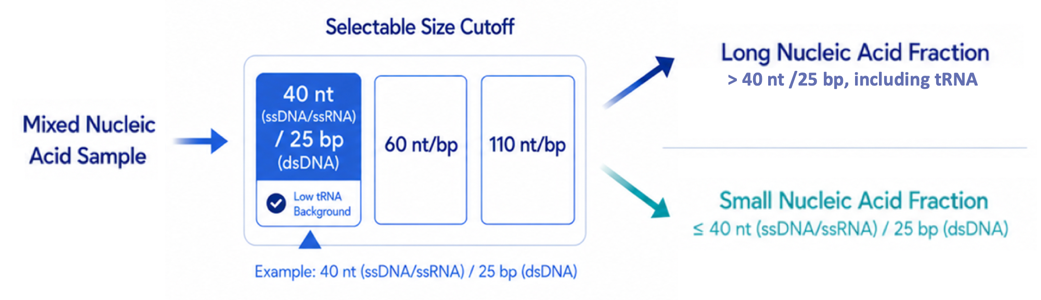
The DeepCatch™ Small Nucleic Acid Fractionation Kit is a precision post-extraction system for purified nucleic acids. Powered by proprietary DeepCatch™ technology, it enables narrow size partitioning, such as enrichment of 10-40 nt single-stranded nucleic acids with depletion of longer background species (Fig 1). The scalable magnetic-bead workflow requires substantially less hands-on time and provides a practical alternative to labor-intensive manual PAGE gel extraction for selected applications.
By reducing background before PCR, library preparation, and sequencing, DeepCatch™ increases the relative representation of informative short fragments and enables more efficient use of downstream assay reagents and sequencing capacity.
User-selectable Size Cutoff
Customize nucleic acid fractionation for your research needs.
KEY BENEFITS
Built for short-fragment enrichment and background depletion
- Enrichment down to 10 nt (see DeepCatch™ Technology Fig 1) Efficiently enrich small and ultra-short nucleic acids as short as 10 nt.
- Precise fractionation (Fig 1)Select from three fractionation modes to enrich defined size ranges: 10–40 nt, 10–60 nt/bp, or 10–110 nt/bp.
- Background reduction (Fig 2)Deplete larger or non-informative nucleic acid populations, such as tRNA, to improve analytical focus.
- Carrier-free workflow (see DeepCatch™ Technology Fig 2)No carrier nucleic acids, PEG, glycogen, LPA, or similar additives are required. This reduces artificial background and improves downstream compatibility.
- Precision fractionation without manual PAGEReplace labor-intensive PAGE gel extraction with a simple, scalable, and automation-ready magnetic bead workflow. Reduced handling improves nucleic acid recovery, helps preserve RNA integrity, and lowers the risk of sample-to-sample cross-contamination.
- Downstream application compatible output (see DeepCatch™ Technology Fig 5A, 5B)Purified fractions are suitable for qPCR, library preparation, and next-generation sequencing.
Three Fractionation Modes
Select the mode that matches your application requirements.
| Mode | Enriched Fraction | Depleted Fraction | Recommended Application |
|---|---|---|---|
| Mode A | 10–40 nt | >40 nt and >25 bp | Small RNA enrichment and background depletion |
| Mode B | 10–60 nt/bp | >60 nt/bp | Ultra-short cfNA enrichment |
| Mode C | 10–110 nt/bp | >110 nt/bp | Sub-nucleosomal and ultra-short cfNA enrichment |
Performance Data
DeepCatch™ Enables Mode-Selectable Fractionation of ssDNA and dsDNA
Three user-selectable modes enable targeted enrichment of ultra-short fragments while depleting longer background species.
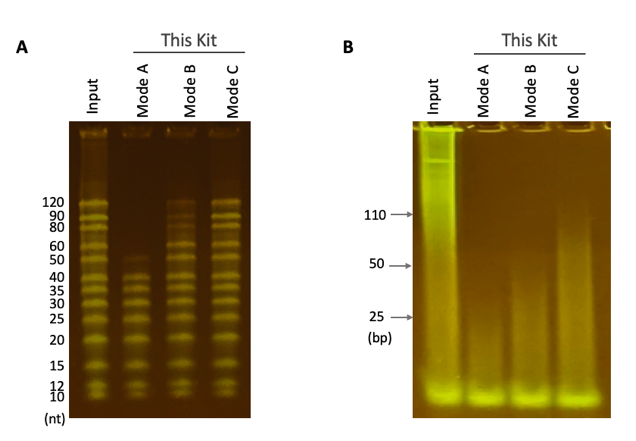
The fractionation capabilities of the DeepCatch™ platform were evaluated using three user-selectable modes (Mode A, B, and C) on both single-stranded and double-stranded inputs.
(A) A custom synthetic single-stranded DNA (ssDNA) marker panel (10–120 nt) was utilized as the input and analyzed on a 15% denaturing urea-PAGE. Mode A efficiently captures the 10–40 nt fraction while effectively depleting >40 nt background species. Modes B and C systematically extend the upper recovery boundary to ~60 nt and ~110 nt, respectively.
(B) A double-stranded DNA (dsDNA) smear generated by partial DNase I digestion of plasmid DNA was used as the input. The sample was fractionated using Modes A, B, and C, and the recovered short-fragment fractions were analyzed on a 10% native PAGE gel. Mode C retained the broadest size range, extending to approximately 110 bp. Mode A produced the most stringent fractionation, depleting dsDNA fragments above approximately 25 bp, whereas Mode B depleted fragments above approximately 60 bp.
The results demonstrate that the effective size cutoff is dependent on the strand state and molecular structure of the input. In Mode A, while ssDNA is enriched up to 40 nt, dsDNA fragments larger than ~25 bp are depleted, resulting in a targeted <25 bp dsDNA fraction. Furthermore, the designated size cutoffs function as nominal guide values rather than an absolute, sharp boundary. (SYBR staining).
Fig 1. Tunable fractionation of single- and double-stranded nucleic acids. The DeepCatch™ Small Nucleic Acid Fractionation Kit provides three distinct modes to enrich ultra-short fragments and deplete larger background molecules. (A) A synthetic ssDNA marker (10–120 nt) fractionated and analyzed on a 15% denaturing urea-PAGE. Mode A selectively enriches 10–40 nt fragments, while Modes B and C shift the enrichment boundary to ~60 nt and ~110 nt, respectively. (B) A partially digested dsDNA smear fractionated and analyzed on a 10% native PAGE. The fractionation behavior is highly dependent on strandedness; for instance, Mode A enriches ssDNA up to 40 nt but restricts dsDNA enrichment to <25 bp. The effective cutoff differs between single- and double-stranded nucleic acids and function as nominal guide values rather than a sharp boundary.(SYBR staining).
High-Efficiency tRNA Depletion for Enhanced Small RNA Signal-to-Noise Ratios
DeepCatch™ Fractionation Kit reduces high-abundance RNA background and improves short-fragment signal-to-noise.
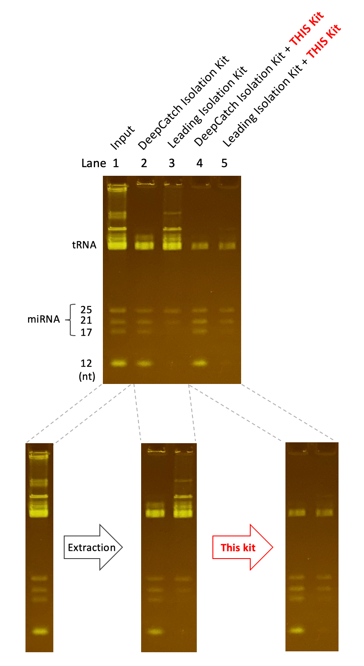
An input sample (Lane 1) comprising bacterial total RNA (prepared by acid phenol/chloroform phase separation followed by isopropanol precipitation), spiked with three synthetic miRNAs (17 nt, 21 nt, 25 nt) and a 12 nt ssDNA marker, was utilized to evaluate background depletion efficiency. The input was first processed using either the DeepCatch™ Small RNA Isolation Kit (Lane 2) or a leading commercial isolation kit (Lane 3). Although the leading commercial kit utilized its large-fragment depletion protocol, it failed to remove the abundant tRNA background. In contrast, the DeepCatch™ Small RNA Isolation Kit effectively removed larger RNA species while also partially depleting tRNA.
The resulting purified eluates were then subjected to Mode A of the DeepCatch™ Small Nucleic Acid Fractionation Kit (Lanes 4 and 5, corresponding to inputs from Lanes 2 and 3, respectively). The fractionation step effectively depleted approximately 90% of the highly abundant tRNA background across both sample sources. Crucially, the ultra-short miRNA targets (17–25 nt) and the 12 nt marker were well retained. (Note: The absence of the 17nt and 12 nt fragment in Lane 5 is due to its absolute loss during the initial extraction step by the leading competitor kit in Lane 3). This robust background depletion dramatically enhances the relative signal-to-noise ratio, ensuring that downstream analytical capacity (such as NGS reads) is focused on biologically relevant ultra-short nucleic acid populations rather than non-informative background. Analyzed on a 15% denaturing urea-PAGE with SYBR staining.
Fig 2. DeepCatch™ Mode A efficiently depletes tRNA to enrich small RNAs. Bacterial total RNA spiked with synthetic miRNAs (17, 21, and 25 nt) and a 12 nt marker was used as input (Lane 1). Primary extraction was performed using the DeepCatch™ Isolation Kit (Lane 2) and a leading competitor isolation kit (Lane 3). While primary extractions left significant tRNA background, subsequent processing of both eluates with the DeepCatch™ Fractionation Kit (Mode A) successfully depleted ~90% of the remaining tRNA (Lanes 4 and 5). Importantly, the ultra-short miRNA targets and 12 nt fragments were well preserved, dramatically improving the signal-to-noise ratio for downstream small RNA profiling. (15% Urea-PAGE, SYBR staining).
Applications
- Small RNA profiling (Fig 2)Enrich miRNA-sized and ultra-short RNA species while reducing tRNA background.
- cfDNA fragmentomicsImprove access to ultra-short and sub-nucleosomal cfDNA populations.
- cfNA biomarker discoveryReveal short cell-free nucleic acid populations that may be masked by abundant background fragments.
- NGS library preparation optimizationReduce non-informative background and improve the proportion of sequencing reads assigned to target fragment populations.
- qPCR and targeted analysisPrepare focused nucleic acid fractions for downstream molecular assays.
Designed for researchers who need more than total nucleic acid recovery.
Conventional purification methods often recover total nucleic acids without resolving which fragments are most informative. DeepCatch™ Small Nucleic Acid Fractionation Kit gives researchers control over fragment size distribution, enabling targeted enrichment of small and ultra-short nucleic acid populations.
This makes the kit especially valuable for studies where signal-to-noise, sequencing efficiency, and short-fragment recovery are critical.
Related Products
For best results, use these kits to recover ultra-short nucleic acids from samples first, then fractionate the purified nucleic acid.